
If people don’t feel safe, your learning will be stifled
Why psychological safety is a crucial foundation for trust, honest learning, and more reliable evidence.
by Patrick Regan and Grace Berry
In this article, we outline how psychological safety is shaped by leadership, team habits, power dynamics, structure, and the everyday experience of how work gets done, and how this impacts organisational learning.
One of the most reassuring phrases in monitoring, evaluation and learning (MEL) can also be one of the most worrying: “No issues to report.” Sometimes that really does mean things are going well. But sometimes it can mean that people do not feel able to say what is actually happening.
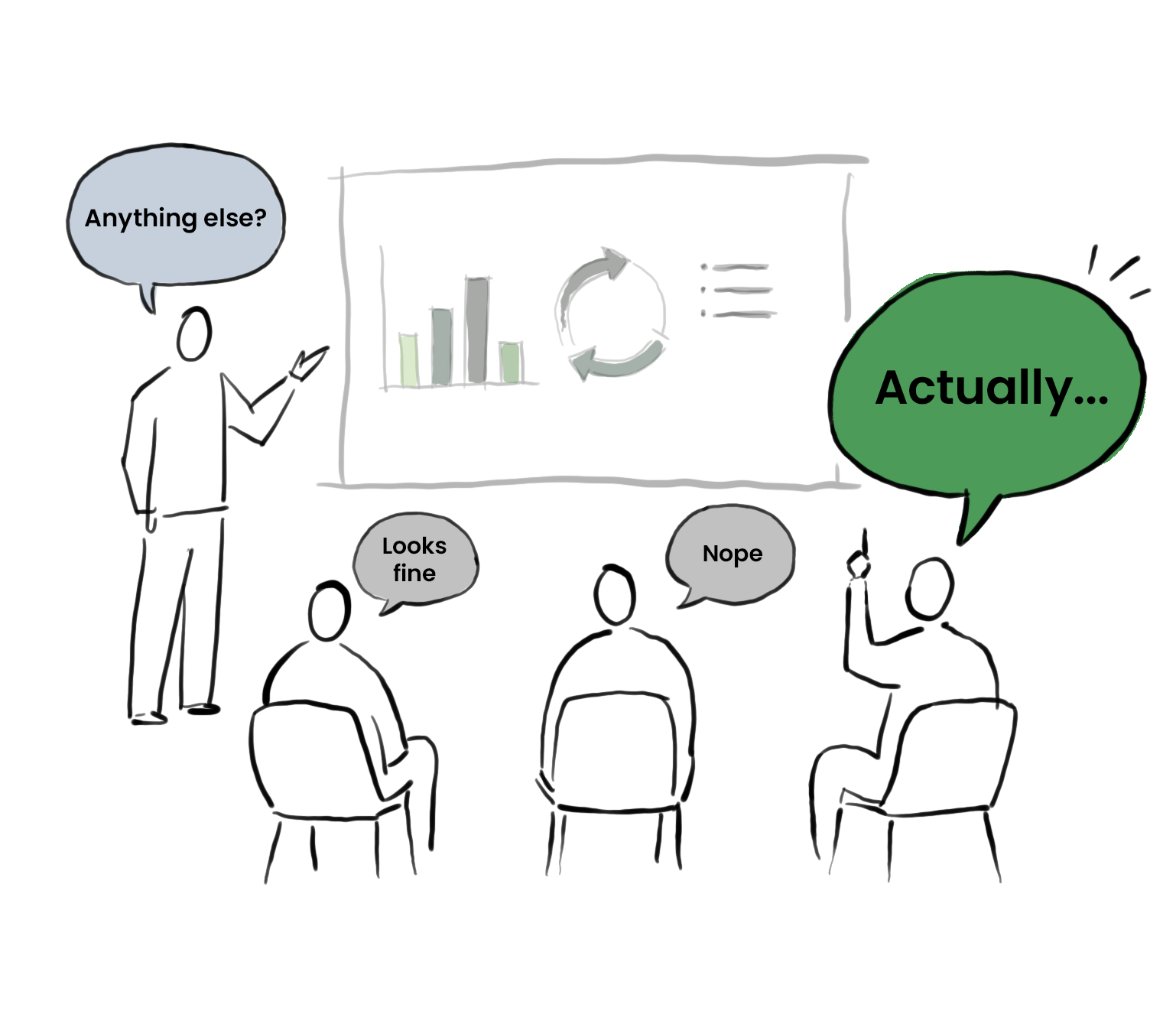
As learning consultants, we’ve all been in spaces where we notice people are not speaking up, or are worried about disagreeing/challenging an idea or perception shared by a more senior member of the team. It is not uncommon that after a group workshop or focus group, someone who had been quieter during the session comes forward to us privately with different ideas, data, insights, or challenges to what was brought up in the session.
In mission-driven organisations, a lot of good MEL depends on people being willing to do things that can feel socially risky: admitting something is not working, raising a concern early, questioning a success story, sharing disappointing data, or saying “I’m not sure this makes sense”. This is one reason why psychological safety matters.
What is psychological safety?
Psychological safety is often defined as a shared belief that it is safe to speak up, ask questions, admit mistakes, and take interpersonal risks without being embarrassed, rejected, or punished [1]. It is not about making everything comfortable or lowering standards. And it is not the same as simply being “nice”. Psychological safety is about whether people feel able to tell the truth and stay in the conversation even when something is difficult, which is key if MEL practices really want to learn.
Why does this matter for MEL?
MEL is not just about collecting data. It is about making sense of what is happening, learning from it, and using that learning to improve decisions and practice so that you can have more impact. That only really works when people are willing to ask the awkward questions, surface the weak spots, reflect honestly, and say when things are less positive than they hoped.
Amy Edmondson (whose work helped define the concept of team psychological safety in the 1990s) showed that psychological safety is closely linked to team learning behaviours such as asking for feedback, seeking help, discussing errors, experimenting, and reflecting together [1]. Saying you “value learning” is only the start; it is these specific practices which show and indicate that learning is actually happening in your organisation. The challenge is that many of those behaviours feel risky if the organisation's culture is defensive, punitive, or overly hierarchical.
Edmondson’s framework also shows that learning depends not just on psychological safety, but also on challenge and accountability. For MEL, teams often need enough safety to speak honestly, and enough challenge to reflect, question, and improve. This is where it can be very helpful to have someone external to your work to facilitate this process from an outside perspective.
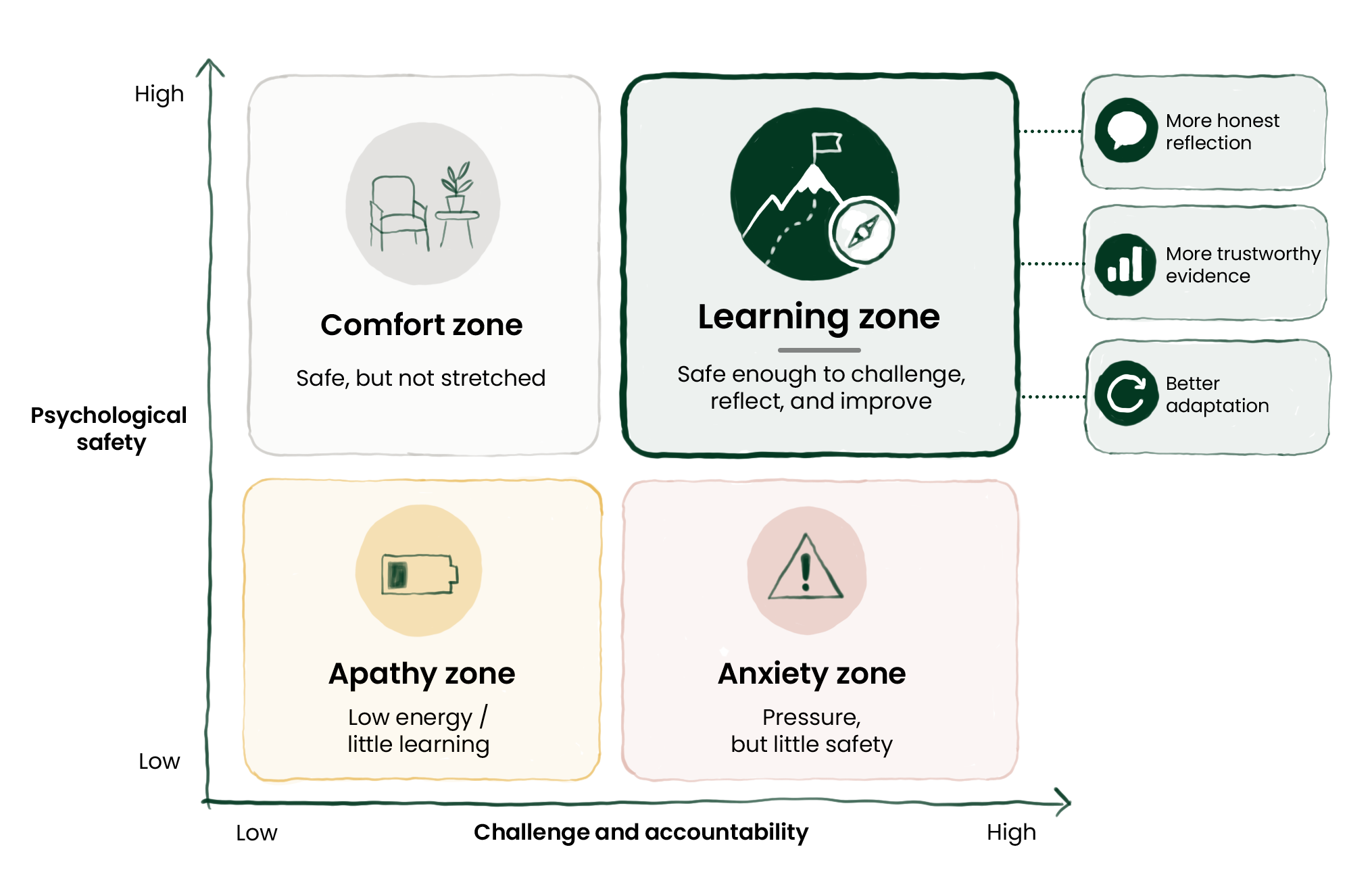
Adapted from Amy Edmondson’s framework, the graph shows how psychological safety and challenge / accountability shape team learning. In MEL, the learning zone is often where the most honest reflection and most useful evidence emerge.
This has a very practical implication for MEL: you can have all the frameworks, indicators, and dashboards in the world, but if people do not feel able to speak honestly, the learning is likely to stay fairly shallow. We have done evaluations where there are very comprehensive monitoring frameworks in place that collect a lot of useful programme data, but isn’t being meaningfully interrogated or used to ask harder questions about a project’s impact. Sometimes, once this line of questioning is introduced, the process is quickly shut down by senior team members – a sign that the monitoring framework is really more focused on “vanity metrics” to make a project look good, without really wanting to truly understand outcomes, impact, or how and why things have or haven’t worked.
Many evaluators and organisations put a lot of emphasis and time into developing methodologies to measure change and impact, but literature consistently finds that honest evaluation depends just as much on culture, leadership, communication, and systems (alongside methodologies) [2][3]. If organisational leaders or decision makers only reward positive stories, if recognising challenges feels dangerous, or if criticism is received defensively, then people learn very quickly what’s safe to say and what isn’t. Psychologically, this can lead to feelings of discomfort, apathy and anxiety. For MEL, it can mean weaker evidence, poorer reflection, and less informed decision-making.
What does this look like in practice?
In reality, low psychological safety isn’t always easy to spot. In fact, it often flies under the radar. Some signs might be:
People speaking freely after a meeting, but not during it
Disappointing results being explained away too quickly
Evaluations that are visually polished but oddly over-positive and lack depth
Teams collecting data without really analysing what it means
Staff feeling pressure to soften, hide, or suppress less positive findings
Report-writing taking priority over honest discussion and shared learning
Lots of agreement on the surface, but very little challenge happening underneath
An important nuance is that harmony is not the same as psychological safety. Research in nonprofit settings suggests that groups can appear respectful and consensus-oriented while still avoiding the challenge, reflection, and questioning that support better decisions [4]. This is particularly important when you are working with partners where there may be cultural differences, exposure to different levels of risk, and power dynamics that make honest communication more risky.
We’ve worked with organisations in the global north that often sub-grant to organisations in the global south who in many cases have had less opportunities for funding, and are exposed to more risks, despite often delivering the most integral aspects of a project – it isn’t until we do an external evaluation, where dedicated learning space has been made, structured in a way where people feel safe, where they share key challenges and hurdles they hadn’t felt able to share before.
Sometimes the barriers are practical as well as cultural. Clear roles, access to information, realistic processes, and good documentation are all important too [3][4]. For instance, if expectations are vague, if systems are overcomplicated, or if people don’t understand how data will be used, then these can all increase defensiveness and reduce authentic engagement.
What helps create a safer learning culture?
The encouraging thing to know is that psychological safety is not set in stone. There are things organisations can do to strengthen it.
Through our research and our experience, we’ve identified a few recurring themes that impact learning cultures:
Leadership matters (a lot). Supportive, fair, and consultative leadership tends to make it easier for people to speak honestly, ask for help, and raise concerns [5][6]. Leaders set the tone by what they do when someone brings bad news, uncertainty, or challenge (and not just by what they say).
Culture is key. If an organisation says it values transparency and learning, but staff experience blame, silence, or defensiveness in practice, trust quickly drops [2][7]. Culture is what people fall back on under pressure. If honesty gets punished when things are difficult, people will prioritise protecting themselves.
Structure is important. Good intentions are not enough. Teams often need shared routines and structured environments that make honest conversation easier, like debriefs, check-ins, reflection points, clear questions, and realistic action planning [3][8]. This kind of structured communication can reduce the interpersonal friction that inherently comes with raising concerns.
Relationships and collaboration help. Trust does not happen automatically because an evaluator arrives with a well-designed framework. Difficult findings tend to land better when key people are involved in the process, and when time is invested in cultivating a relationship, credibility, and care in the process [2]. This is one reason why collaborative sense-making can be so useful; if people are involved in interpreting findings, they are often less defensive and more willing to use them [3].
It is also worth being realistic about human behaviour. The choice people make about whether to speak up does not happen in a vacuum. Fear, hierarchy, burnout, past experiences, and self-protection all contribute to shaping what feels possible in the moment [9]. Therefore, safer learning cultures need a two-pronged approach, in terms of both interpersonal safety and the systems that support it.
Psychological safety and accountability
Importantly, psychological safety is fundamental for accountability. In fact, high levels of psychological safety should make accountability easier, because it makes it more possible to name problems clearly, challenge constructively, and deal with risks before they become bigger issues [1][7].
This is particularly important in the kinds of organisations many of us work within: Values-led, often operating under pressure, and often trying to learn in the midst of complexity. Ultimately, if we aren’t investing in our own learning practices, and if we are not fostering an environment where people can speak honestly and openly, we are not doing justice to the communities we are trying to support.
Creating spaces and an atmosphere of trust and openness within your organisation, with your partners, and with the communities is one of the key differences in actually being able to meet a need and have impact for communities, rather than just appearing like you do for donors and board members.
Psychological safety can provide the bedrock that helps organisations learn, adjust, and stand the test of time – so when was the last time you made a conscious effort to foster learning in your organisation? Do you need help getting into the learning zone, if so get in touch!
References:
[1] Edmondson, A. (1999). Psychological safety and learning behavior in work teams. https://doi.org/10.2307/2666999.
[2] McCoy, A. AEA365 blog. Challenges of sharing truth through evaluation in the non-profit sector.
[3] Preskill, H., & Torres, R. Evaluative Inquiry for Learning in Organizations.
[4] Dowley, L. (2006). Research on psychological safety and learning behaviours in nonprofit governance settings.
[5] Bano, S., & Imran, M. (2024). Research on leadership, psychological safety, and performance in NGO contexts.
[6] McKinsey & Company. Psychological safety and the critical role of leadership development.
[7] Nonprofit Risk Management Center. Safe and Supported: The Intersection of Psychological Safety and Fruitful Risk Practice; Workplace Culture: The Foundation for Sound Risk Practice.
[8] Ridley et al. (2021). Research on structured interventions to improve communication and speaking up.
[9] Wawersik et al. (2023). Review of barriers and enablers to speaking up, including fear, hierarchy, confidence, and burnout.